1 The Lost Island of Atlantis
One of the oldest mysteries in the world, the legend of Atlantis has mystified humanity since ancient times. According to the Greek philosopher Plato, Atlantis was a large island somewhere west of the Pillars of Hercules (the Rock of Gibraltar) and the home of an incredibly advanced civilization known as the Atlanteans. Plato described Atlantis as a place of immense beauty with a palace compound in the center of three ringed canals. He said that every king that inherited the palace would add to it, trying to surpass his predecessor and by doing so they made it a palace that surpassed any other in both beauty and wealth. The Atlanteans themselves were blessed with wealth but at the same they were incredibly ambitious, constantly seeking power. Atlantis is said to have met its end when it was hit by a giant earthquake and swallowed by the sea. But is any of this the truth or is the story of Atlantis just a myth?
Theories
It seems that everyone who has ever studied Greek history has a theory as to Atlantis’ location. Also, many other cultures have stories of a great flood and even the name Atlantis isn’t exclusive to the Greeks: the Basques have Atlaintica, the Vikings have Atli, the Northern Africans have Attala, the Aztecs have Aztlan and on the Canary Islands there are legends of Atalaya. Proposed locations of Atlantis: Santorini in Greece, the Bermuda Triangle, the Atlas Mountains of Morocco and Tunisia, the Azores archipelago (Portugal), Greece’s Crete and even Sweden. It has also been said that some Atlanteans survived and went on to settle in England (Druids), Hellenic Greece, the New World (Mayas and Incas) and Egypt.
2 The Ark of the Covenant
The Ark of the Covenant has fascinated people since it was first mentioned in the Bible in Exodus 25. God instructed Moses to construct a Tabernacle where the Israelites could worship God, and inside it would be a special room called the Holy of Holies where the Ark would be placed. Made from acacia wood covered in gold, it was topped with two cherubs whose wings covered what was called the Mercy Seat. It contained three precious artifacts, the two stone tablets that contained the Ten Commandments, the Rod of Aaron and a golden pot of manna. It has also been said that God himself resided between the wings of the two cherubs on the Jewish Day of Atonement, Yum Kippur. The Ark was not only the center of the Israelite faith, but it also had supernatural powers and was able to defeat their enemies.
Theories
The main question we have to ask when talking about the Ark of the Covenant is did it ever really exist. The Ark was supposedly kept in the Temple of Solomon until it was destroyed by the Babylonians in 586 BC and has never been seen again. Then, if it did really exist to begin with, did the Babylonians destroy it or was it moved or captured? The Second Book of the Maccabees and the Book of Revelation state that the Ark no longer exists but there have been claims that it is hidden away in: Mount Nebo in Jordan, the Temple Mount in Jerusalem, the Church of Our Lady Mary of Zion in Ethiopia, South Africa, Zimbabwe, Languedoc in France, Herdewyke in the UK, the Hill of Tara in Ireland and the limestone caves under Mount Tsurugi in Japan.
3 King Arthur
Did one of the most famous kings ever really exist or was his legend just a way to inspire English troops? One of the first times he is mentioned is by a Welsh cleric named Nennius in his Historia Brittonum in the 9th century. However, the most comprehensive account that is known is Geoffrey of Monmouth’s History of the Kings of Britain, which dates back to the 12th century. Monmouth claimed that Arthur was unsurpassed in power and diplomacy, a great warrior king who ruled Wales, Scotland, Ireland, Norway, Denmark, Germany, Brittany, Normandy and Gaul. Mounmouth’s supposed history is completely false, but that didn’t stop the world from falling in love with and continuing the Arthurian legend.
Theories
While Arthur is a truly mythical king, his legend could have been based on several real people from history. One on the strongest theories was that Arthur was really a Roman commander named Lucius Artorius Castus who led 5,500 Sarmatians in Britain at the end of the second century. Despite the lack of historical evidence, some still believe that King Arthur once ruled Britain and that his tomb is still out there to be found.
4 The Riddle of the Sphinx
When one thinks of the Sphinx, they immediately think of the Great Sphinx at Giza, but the Sphinx was a powerful symbol in Greece, Phoenicia and Syria as well. In fact Riddle of the Sphinx originates in Greek legend. According to the ancient Greeks, if a man crossed its path the Sphinx would ask, “What is the creature that walks on four legs in the morning, two legs in the afternoon and three in the evening?” If they couldn’t answer, the Sphinx would devour them; however, if they answered correctly, the Sphinx would destroy itself. The only person said to survive an encounter with the Sphinx was the Greek hero Oedipus who answered “man.”
Despite the riddle being solved, the Great Sphinx still poses many questions. How old is it? Who built it? And what was the purpose of the passageways?
Theories
Archeologists have heavily contested the age of the Great Sphinx. Conventional science believes the Sphinx was carved around 2500 BC by the Pharaoh Kafre. However, in 1989, author John Anthony West and geologist Robert M. Schoch determined that it was much older and that Kafre had it remodeled into his likeness. As for the passageways, three have been found already and several non-evasive exploration techniques have uncovered anomalies in the Sphinx that could either be man-made chambers or natural faults in the rock.
5 The Amber Room
Originally built in 1701 for the first King of Prussia, it was soon moved to Russia as a gift to Peter the Great, only to be moved again to the Winter Palace by Tsarina Elizabeth. The room covered more than 55 square meters and it took 10 years to construct out of six tons of Baltic amber. When Hitler’s army was encroaching on the Soviet Union, curators tried moving the room once more, but the amber had become brittle, so they hid it behind plain wallpaper. However, the Nazis knew where to look for the famous work of art and soldiers disassembled the room so it could be sent to Konigsberg. Konigsberg Castle was heavily bombed by the Royal Air Force later in the war and was further destroyed by the advancing Soviet Army. Despite some reports eventually getting out that stated that the Amber Room had survived the war, it has never been seen again.
Theories
Some people believe that the Amber Room was destroyed by the bombing and lost forever. However, several other theories have been formulated: that it is still hidden in an underground bunker at Konigsberg, that it is buried in a mine in the Ore Mountains or that it was aboard a submarine or ship in the Baltic Sea that was sunk by the Soviet Navy. In 1997, one stone mosaic that had decorated the room was discovered in Western Germany, in the hands of a family of a soldier who had helped disassemble the Amber Room. The rest of it has never been found, despite several claims to the contrary.
6 The Crystal Skulls

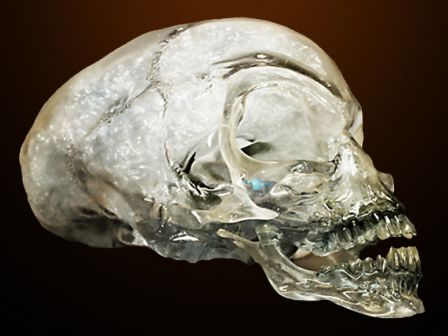
Gaining recent popularity with the release of the newest Indiana Jones movie, the mystery of the Crystal Skulls goes all the way back to 1881 when the first two skulls were found by Mexican mercenaries. Thirteen crystal skulls have been found throughout Central and South America. Possibly the most famous skull ever found is the Mitchel-Hedges Skull, claimed to be found by seventeen year old Anna Mitchel-Hedges while accompanying her father Frederick Albert Mitchel-Hedges on an expedition to what is now Belize. It was later revealed that Mitchel-Hedges bought the skull at an auction at Sotheby’s in London in 1943. The Mitchel-Hedges skull is unique in that it is an anatomically correct representation, complete with a removable mandible. The other famous skull is the British Museum skull, possibly bought by a mercenary in Mexico and then sold to an artifact trader named Eugene Bodan, who sold it to Tiffany’s, who in turn sold it to the British Museum. Other notable crystal skulls include the Paris Skull (which was found at the same time as the British Museum Skull), the Smithsonian Skull, the Mayan Skull, the Amethyst Skull, the Texas Skull (nicknamed Max), the ET Skull (given the nickname because of its pointed cranium and exaggerated overbite), the Rose Quartz Skull, and the Brazilian Skull. (Image: the Mitchell-Hedges Skull.)
Theories
The Crystal Skulls were thought to be carved by the Mayans or the Aztecs for a long time. However, more outlandish theories have emerged over the years. Some theories: that they were created by aliens, that they came from Atlantis or Lemuria, or even that they were left behind by a society that now lives in the hollow center of the earth. Claims that they were carved with technology well beyond the reach of the Mayans and Aztecs have added to their mystery.
7 The Tomb of Vlad Dracula
Most famous as Bram Stoker’s vampire character, Count Dracula, the real Dracula was actually a prince of Wallachia (now part of Romania). A defender against the Turks, he has been portrayed as both a patriotic hero and a ruthless villain. Vlad Dracula was a merciless ruler who impaled and tortured between 40,000 and 100,000 of his enemies, both Turks and fellow countrymen who posed a threat to his power. After three separate reigns, he was killed in battle against the Turks near Bucharest in 1476. The Turks cut off his head and sent it to the Sultan of the Ottoman Empire, Mehmed II. The final resting place of the rest of his body is unknown.
Theories
The most widely accepted theory about Vlad’s tomb is that he was buried at the island monastery of Snagov. However, after several archeological excavations of the island, Vlad’s body was not recovered. The other speculation is that Vlad’s body may have been originally buried at the Comana Monastery, however, the monastery was rebuilt in the seventeenth century and no body has ever been found there, either. Another option comes from superstition, because of tales of vampires running rampant in Wallachia at the time- Vlad could have been moved anywhere to protect the monks from being killed in their sleep.
8 The Assassination of John F. Kennedy
John F. Kennedy was shot once in the back and once in head while riding with his wife Jacqueline in a Presidential motorcade through the streets of Dallas, Texas on November 22, 1963. Lee Harvey Oswald was arrested 45 minutes after the shots were fired. After hours of interrogation, in which none of the proper procedures were followed, he was accused of murder. He was killed by Jack Ruby in the garage of the police building on November 24 in front of hundreds of journalists. On November 29, President Lyndon B. Johnson created the Warren Commission to investigate the assassination. It was headed by Earl Warren, the Chief Justice of the United States, and found that Oswald was the lone shooter and that he did it from the sixth floor of the Schoolbook Depository Building with an Italian Mannlicher-Carcano rifle.
Theories
Many of the conspiracy theories that surround the assassination began the day that the Warren Commission’s results were released. The most prominent theory is that there was more than one shooter, either somewhere else in Dealey Plaza or on the grassy knoll. Other conspiracy theories include cover-ups by the Federal Reserve, the CIA, the Secret Service, Cuban exiles, CIA agent E. Howard Hunt, the Mafia, Lyndon Johnson, the American Fact-Finding Committee, the Soviet Bloc and the Israeli government.
9 The Mystery of Stonehenge
Built in three sections over 6,400 years by the Neolithic inhabitants of Salisbury plain Southern England , Stonehenge has captivated visitors for thousands of years. The site contains 30 sarcens (upright stones) weighing 26 tons and 30 lintels (horizontal top stones). Each stone weighs 6 tons and was carved from bluestone from a location several miles away. The Neolithic builders were able to create a monumental that has perplexed humanity for thousands of years using only stone tools, and without using draft animals. Even after all these years, nobody really knows why Stonehenge was built. The other mysteries surrounding Stonehenge are its construction and the significance of the giant blue stones used. Also mysterious: the people who built Stonehenge (we know very little about them because they left no written history).
Theories
The theories about Stonehenge’s construction range from glaciers moving the enormous bluestones to ropes and timbers, to aliens. As for its purpose it has been said to be a temple, a secular calendar, and that the bluestones themselves have healing powers. As a result of the recent discovery of a vast number of burials around the site, a new theory has emerged, one that states that Stonehenge was a place to celebrate the lives of the dead.
10 Jack the Ripper

One of the oldest unsolved murder cases in the world, Jack the Ripper instilled fear into the heart of Victorian London and still captures our imagination today. Between August and November 1888, five prostitutes were murdered in Whitechapel, an area in the East End of London. Despite the wealth of Victorian London, the East End was a very impoverished area of the city- home to many Jewish refugees from Russia, Poland and Romania. Whitechapel also had the highest crime rate in the city. Everything about the murders seems to be shrouded in mystery, from the identity of the killer to the letters that were sent to the police. Even the number of victims is under scrutiny. It is generally accepted that there were five victims of Jack the Ripper: Mary Ann (Polly) Nichols (Aug. 31, 1888), Annie Chapman (Sept. 30, 1888), Elizabeth Stride (Sept. 30, 1888), Catherine Eddowes (also Sept. 30, 1888) and Mary Jane (Marie Jeanette) Kelly (Nov. 9, 1888). However, some sources say there were only four victims, while others say there were as many as nine. As for the matter of the letters, it is commonly believed that they were a hoax despite containing graphic details of the murders. Recently it has been thought that Tom Bulling, a journalist from the Central News Agency, wrote the letters. However, some still believe that all, or at least some, of the letters actually were written by the killer, particularly the letter that was sent to George Lusk with half a human kidney. The story of Jack the Ripper had a real effect on, not only the rest of London, but also the entire British Empire. The legend played on the fears that poverty, crime, disease and social unrest were at their doorstep, and Jack the Ripper became the personification of all these evils.
Theories
For the last 120 years the case of the Whitechapel Murderer has been unsolved and this has led to many theories including hundreds of Victorian Londoners. The most accepted suspects are Montague John Druitt, Michael Ostrog, Aaron Kosminski, George Chapman, Thomas Cutbrush and more recently Dr Francis J. Tumblety. Other theorized suspects include Prince Albert Victor Christian Edward (who would later become King Edward VII), author and mathematician Lewis Carroll, Dr. T. Neil Cream, criminal Frederick Deeming, Walter Sickert, poet Francis Thompson and even an unknown woman who was dubbed Jill the Ripper. 


 Iceland is considered to be one of the world’s most beautiful countries because of the breathtaking nature, but they can still enjoy that due to the high level of accomplishing the environmental policy goals. People in Iceland use the geothermal energy very well, while the most used electricity and heat source is the hydrogen. Believe it or not, amazing 82% of the electricity and heat in Iceland comes from hydrogen and geothermal sources, while only 18% comes from coal. The first place for the greenest country is well deserved.
  Switzerland was leading the EPI list years ago, but now has fallen to the second place just due to incredible Iceland performance. However, Swiss are still working hard for creating greener society. The government has imposed a fee for disposing thrash in the country, but the people are pretty interested for ecology as well. For example, there are cities, smaller towns actually, in which using car is prohibited. That’s how Switzerland remains on the top of this list for years.
  Costa Rica government is strongly committed to following the Icelandic example for use of renewable energy sources. They have set a goal to become carbon neutral until 2021! The land suffered deforestation for years in order to be made space for agriculture, but now one of the main goals is reforestation of the country, planting over five million trees over last five years.
  One of the first things when visiting Stockholm, Sweden, is noticing the wide range of eco-friendly products. Nevertheless, the most important thing that put them so high on the EPI list is the fact that they are in advanced phase of the implementation of the plan for phasing out the fossil fuel by 2020. Swedish government also is trying hard to use the forests very well, as the sawdust of the lumber is used for generating heat. These are just some of the indicators that make Sweden on of the greenest on the world, but explaining all of them would take a lot of space.
  Norway already feels the consequences of the global warming, as its north parts are close to the melting Arctic, so they’re taking a lot of measure to prevent any possible catastrophic scenario. Norway government and the people as well, are making efforts to become carbon neutral until 2030, although it is an oil export oriented country. They plan to make diesel fuel more expensive than the eco fuels and stimulate people to use the second ones.
  Maybe you will be surprised of the fact that one African Prime Minister decide to make his country eco-friendly, but yes, it’s true. Although the little island has very limited resources, they do not give up. Rama Sithanen’s cabinet is trying to find many ways for reuse items through recycling. At this moment they rely on the water that surrounds the island.
  The indicators that launched France so high on the EPI list are increasing of use of eco fuels, conserving energy, increasing renewable energy rate, increasing of organic farming, etc. In order to stimulate the use of eco friendly energy sources, the government also promoted reduction of taxes for those who use solar panels. However, the most interesting measure toward accomplishing their eco goals is the use of, believe it or not, the straw bales for construction of buildings.
  Austria has no problems for being green so they decided to go step further. They made a deal with the government of Czech Republic for building eco friendly garden across the border between the two countries. The gardens contain herbs, fruit trees and flowers; they look amazing, though they do not use any pesticides for maintaining it. For the rest of the green country there’s no need to waste words.
  Cuba has earned the same index as Austria mostly thanks to the decreasing of the use of harmful and illegal pesticides on farms. Allegedly, they try to lower the sea level in order to prevent the salt water ruin the soil. However, their most ambitious project is the use of clear hydroelectricity in the Guama area. The government makes efforts to connect all of the homes in that area to hydroelectric station and provide them all the electricity they need. Should that make success, other projects will follow.
  Most news we hear for Colombia are not good, so this including on the Top 10 EPI countries is really refreshing. The government learnt the lessons and finally decided to end the deforestation and stimulated a lot of eco friendly projects. Constructors began using bamboo instead of steel; a lot of national parks have been opened in order to be saved the large number of endemic species, while the fashion designers have also tried to raise the awareness about the green issues.






 Posts
Posts


