This is default featured slide 1 title

Go to Blogger edit html and find these sentences.Now replace these sentences with your own descriptions.This theme is Bloggerized by Lasantha Bandara - Premiumbloggertemplates.com.

This is default featured slide 2 title

Go to Blogger edit html and find these sentences.Now replace these sentences with your own descriptions.This theme is Bloggerized by Lasantha Bandara - Premiumbloggertemplates.com.

This is default featured slide 3 title

Go to Blogger edit html and find these sentences.Now replace these sentences with your own descriptions.This theme is Bloggerized by Lasantha Bandara - Premiumbloggertemplates.com.

This is default featured slide 4 title

Go to Blogger edit html and find these sentences.Now replace these sentences with your own descriptions.This theme is Bloggerized by Lasantha Bandara - Premiumbloggertemplates.com.

This is default featured slide 5 title

Go to Blogger edit html and find these sentences.Now replace these sentences with your own descriptions.This theme is Bloggerized by Lasantha Bandara - Premiumbloggertemplates.com.

Saturday, 14 July 2012

Top 10 Historical Mysteries


1 The Lost Island of Atlantis

One of the oldest mysteries in the world, the legend of Atlantis has mystified humanity since ancient times. According to the Greek philosopher Plato, Atlantis was a large island somewhere west of the Pillars of Hercules (the Rock of Gibraltar) and the home of an incredibly advanced civilization known as the Atlanteans. Plato described Atlantis as a place of immense beauty with a palace compound in the center of three ringed canals. He said that every king that inherited the palace would add to it, trying to surpass his predecessor and by doing so they made it a palace that surpassed any other in both beauty and wealth. The Atlanteans themselves were blessed with wealth but at the same they were incredibly ambitious, constantly seeking power. Atlantis is said to have met its end when it was hit by a giant earthquake and swallowed by the sea. But is any of this the truth or is the story of Atlantis just a myth?
Theories
It seems that everyone who has ever studied Greek history has a theory as to Atlantis’ location. Also, many other cultures have stories of a great flood and even the name Atlantis isn’t exclusive to the Greeks: the Basques have Atlaintica, the Vikings have Atli, the Northern Africans have Attala, the Aztecs have Aztlan and on the Canary Islands there are legends of Atalaya. Proposed locations of Atlantis: Santorini in Greece, the Bermuda Triangle, the Atlas Mountains of Morocco and Tunisia, the Azores archipelago (Portugal), Greece’s Crete and even Sweden. It has also been said that some Atlanteans survived and went on to settle in England (Druids), Hellenic Greece, the New World (Mayas and Incas) and Egypt.

2 The Ark of the Covenant
The Ark of the Covenant has fascinated people since it was first mentioned in the Bible in Exodus 25. God instructed Moses to construct a Tabernacle where the Israelites could worship God, and inside it would be a special room called the Holy of Holies where the Ark would be placed. Made from acacia wood covered in gold, it was topped with two cherubs whose wings covered what was called the Mercy Seat. It contained three precious artifacts, the two stone tablets that contained the Ten Commandments, the Rod of Aaron and a golden pot of manna. It has also been said that God himself resided between the wings of the two cherubs on the Jewish Day of Atonement, Yum Kippur. The Ark was not only the center of the Israelite faith, but it also had supernatural powers and was able to defeat their enemies.
Theories
The main question we have to ask when talking about the Ark of the Covenant is did it ever really exist. The Ark was supposedly kept in the Temple of Solomon until it was destroyed by the Babylonians in 586 BC and has never been seen again. Then, if it did really exist to begin with, did the Babylonians destroy it or was it moved or captured? The Second Book of the Maccabees and the Book of Revelation state that the Ark no longer exists but there have been claims that it is hidden away in: Mount Nebo in Jordan, the Temple Mount in Jerusalem, the Church of Our Lady Mary of Zion in Ethiopia, South Africa, Zimbabwe, Languedoc in France, Herdewyke in the UK, the Hill of Tara in Ireland and the limestone caves under Mount Tsurugi in Japan.


3 King Arthur

Did one of the most famous kings ever really exist or was his legend just a way to inspire English troops? One of the first times he is mentioned is by a Welsh cleric named Nennius in his Historia Brittonum in the 9th century. However, the most comprehensive account that is known is Geoffrey of Monmouth’s History of the Kings of Britain, which dates back to the 12th century. Monmouth claimed that Arthur was unsurpassed in power and diplomacy, a great warrior king who ruled Wales, Scotland, Ireland, Norway, Denmark, Germany, Brittany, Normandy and Gaul. Mounmouth’s supposed history is completely false, but that didn’t stop the world from falling in love with and continuing the Arthurian legend.
Theories
While Arthur is a truly mythical king, his legend could have been based on several real people from history. One on the strongest theories was that Arthur was really a Roman commander named Lucius Artorius Castus who led 5,500 Sarmatians in Britain at the end of the second century. Despite the lack of historical evidence, some still believe that King Arthur once ruled Britain and that his tomb is still out there to be found.


4 The Riddle of the Sphinx


When one thinks of the Sphinx, they immediately think of the Great Sphinx at Giza, but the Sphinx was a powerful symbol in Greece, Phoenicia and Syria as well. In fact Riddle of the Sphinx originates in Greek legend. According to the ancient Greeks, if a man crossed its path the Sphinx would ask, “What is the creature that walks on four legs in the morning, two legs in the afternoon and three in the evening?” If they couldn’t answer, the Sphinx would devour them; however, if they answered correctly, the Sphinx would destroy itself. The only person said to survive an encounter with the Sphinx was the Greek hero Oedipus who answered “man.”
Despite the riddle being solved, the Great Sphinx still poses many questions. How old is it? Who built it? And what was the purpose of the passageways?
Theories
Archeologists have heavily contested the age of the Great Sphinx. Conventional science believes the Sphinx was carved around 2500 BC by the Pharaoh Kafre. However, in 1989, author John Anthony West and geologist Robert M. Schoch determined that it was much older and that Kafre had it remodeled into his likeness. As for the passageways, three have been found already and several non-evasive exploration techniques have uncovered anomalies in the Sphinx that could either be man-made chambers or natural faults in the rock.


5 The Amber Room


Originally built in 1701 for the first King of Prussia, it was soon moved to Russia as a gift to Peter the Great, only to be moved again to the Winter Palace by Tsarina Elizabeth. The room covered more than 55 square meters and it took 10 years to construct out of six tons of Baltic amber. When Hitler’s army was encroaching on the Soviet Union, curators tried moving the room once more, but the amber had become brittle, so they hid it behind plain wallpaper. However, the Nazis knew where to look for the famous work of art and soldiers disassembled the room so it could be sent to Konigsberg. Konigsberg Castle was heavily bombed by the Royal Air Force later in the war and was further destroyed by the advancing Soviet Army. Despite some reports eventually getting out that stated that the Amber Room had survived the war, it has never been seen again.
Theories
Some people believe that the Amber Room was destroyed by the bombing and lost forever. However, several other theories have been formulated: that it is still hidden in an underground bunker at Konigsberg, that it is buried in a mine in the Ore Mountains or that it was aboard a submarine or ship in the Baltic Sea that was sunk by the Soviet Navy. In 1997, one stone mosaic that had decorated the room was discovered in Western Germany, in the hands of a family of a soldier who had helped disassemble the Amber Room. The rest of it has never been found, despite several claims to the contrary.


6 The Crystal Skulls
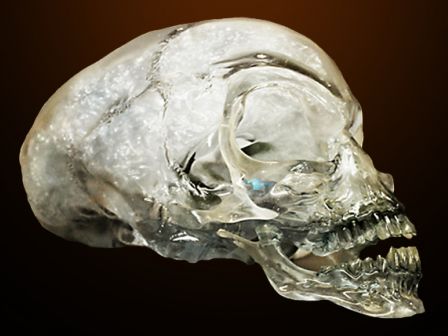
Gaining recent popularity with the release of the newest Indiana Jones movie, the mystery of the Crystal Skulls goes all the way back to 1881 when the first two skulls were found by Mexican mercenaries. Thirteen crystal skulls have been found throughout Central and South America. Possibly the most famous skull ever found is the Mitchel-Hedges Skull, claimed to be found by seventeen year old Anna Mitchel-Hedges while accompanying her father Frederick Albert Mitchel-Hedges on an expedition to what is now Belize. It was later revealed that Mitchel-Hedges bought the skull at an auction at Sotheby’s in London in 1943. The Mitchel-Hedges skull is unique in that it is an anatomically correct representation, complete with a removable mandible. The other famous skull is the British Museum skull, possibly bought by a mercenary in Mexico and then sold to an artifact trader named Eugene Bodan, who sold it to Tiffany’s, who in turn sold it to the British Museum. Other notable crystal skulls include the Paris Skull (which was found at the same time as the British Museum Skull), the Smithsonian Skull, the Mayan Skull, the Amethyst Skull, the Texas Skull (nicknamed Max), the ET Skull (given the nickname because of its pointed cranium and exaggerated overbite), the Rose Quartz Skull, and the Brazilian Skull. (Image: the Mitchell-Hedges Skull.)
Theories
The Crystal Skulls were thought to be carved by the Mayans or the Aztecs for a long time. However, more outlandish theories have emerged over the years. Some theories: that they were created by aliens, that they came from Atlantis or Lemuria, or even that they were left behind by a society that now lives in the hollow center of the earth. Claims that they were carved with technology well beyond the reach of the Mayans and Aztecs have added to their mystery.


7 The Tomb of Vlad Dracula

Most famous as Bram Stoker’s vampire character, Count Dracula, the real Dracula was actually a prince of Wallachia (now part of Romania). A defender against the Turks, he has been portrayed as both a patriotic hero and a ruthless villain. Vlad Dracula was a merciless ruler who impaled and tortured between 40,000 and 100,000 of his enemies, both Turks and fellow countrymen who posed a threat to his power. After three separate reigns, he was killed in battle against the Turks near Bucharest in 1476. The Turks cut off his head and sent it to the Sultan of the Ottoman Empire, Mehmed II. The final resting place of the rest of his body is unknown.
Theories
The most widely accepted theory about Vlad’s tomb is that he was buried at the island monastery of Snagov. However, after several archeological excavations of the island, Vlad’s body was not recovered. The other speculation is that Vlad’s body may have been originally buried at the Comana Monastery, however, the monastery was rebuilt in the seventeenth century and no body has ever been found there, either. Another option comes from superstition, because of tales of vampires running rampant in Wallachia at the time- Vlad could have been moved anywhere to protect the monks from being killed in their sleep.


8 The Assassination of John F. Kennedy

John F. Kennedy was shot once in the back and once in head while riding with his wife Jacqueline in a Presidential motorcade through the streets of Dallas, Texas on November 22, 1963. Lee Harvey Oswald was arrested 45 minutes after the shots were fired.  After hours of interrogation, in which none of the proper procedures were followed, he was accused of murder. He was killed by Jack Ruby in the garage of the police building on November 24 in front of hundreds of journalists. On November 29, President Lyndon B. Johnson created the Warren Commission to investigate the assassination. It was headed by Earl Warren, the Chief Justice of the United States, and found that Oswald was the lone shooter and that he did it from the sixth floor of the Schoolbook Depository Building with an Italian Mannlicher-Carcano rifle.
Theories
Many of the conspiracy theories that surround the assassination began the day that the Warren Commission’s results were released. The most prominent theory is that there was more than one shooter, either somewhere else in Dealey Plaza or on the grassy knoll. Other conspiracy theories include cover-ups by the Federal Reserve, the CIA, the Secret Service, Cuban exiles, CIA agent E. Howard Hunt, the Mafia, Lyndon Johnson, the American Fact-Finding Committee, the Soviet Bloc and the Israeli government.


9 The Mystery of Stonehenge
Built in three sections over 6,400 years by the Neolithic inhabitants of Salisbury plain Southern England , Stonehenge has captivated visitors for thousands of years. The site contains 30 sarcens (upright stones) weighing 26 tons and 30 lintels (horizontal top stones). Each stone weighs 6 tons and was carved from bluestone from a location several miles away. The Neolithic builders were able to create a monumental that has perplexed humanity for thousands of years using only stone tools, and without using draft animals. Even after all these years, nobody really knows why Stonehenge was built. The other mysteries surrounding Stonehenge are its construction and the significance of the giant blue stones used. Also mysterious: the people who built Stonehenge (we know very little about them because they left no written history).
Theories
The theories about Stonehenge’s construction range from glaciers moving the enormous bluestones to ropes and timbers, to aliens. As for its purpose it has been said to be a temple, a secular calendar, and that the bluestones themselves have healing powers. As a result of the recent discovery of a vast number of burials around the site, a new theory has emerged, one that states that Stonehenge was a place to celebrate the lives of the dead.


10 Jack the Ripper
One of the oldest unsolved murder cases in the world, Jack the Ripper instilled fear into the heart of Victorian London and still captures our imagination today. Between August and November 1888, five prostitutes were murdered in Whitechapel, an area in the East End of London. Despite the wealth of Victorian London, the East End was a very impoverished area of the city- home to many Jewish refugees from Russia, Poland and Romania. Whitechapel also had the highest crime rate in the city. Everything about the murders seems to be shrouded in mystery, from the identity of the killer to the letters that were sent to the police. Even the number of victims is under scrutiny. It is generally accepted that there were five victims of Jack the Ripper: Mary Ann (Polly) Nichols (Aug. 31, 1888), Annie Chapman (Sept. 30, 1888), Elizabeth Stride (Sept. 30, 1888), Catherine Eddowes (also Sept. 30, 1888) and Mary Jane (Marie Jeanette) Kelly (Nov. 9, 1888). However, some sources say there were only four victims, while others say there were as many as nine. As for the matter of the letters, it is commonly believed that they were a hoax despite containing graphic details of the murders. Recently it has been thought that Tom Bulling, a journalist from the Central News Agency, wrote the letters. However, some still believe that all, or at least some, of the letters actually were written by the killer, particularly the letter that was sent to George Lusk with half a human kidney. The story of Jack the Ripper had a real effect on, not only the rest of London, but also the entire British Empire. The legend played on the fears that poverty, crime, disease and social unrest were at their doorstep, and Jack the Ripper became the personification of all these evils.
Theories
For the last 120 years the case of the Whitechapel Murderer has been unsolved and this has led to many theories including hundreds of Victorian Londoners. The most accepted suspects are Montague John Druitt, Michael Ostrog, Aaron Kosminski, George Chapman, Thomas Cutbrush and more recently Dr Francis J. Tumblety. Other theorized suspects include Prince Albert Victor Christian Edward (who would later become King Edward VII), author and mathematician Lewis Carroll, Dr. T. Neil Cream, criminal Frederick Deeming, Walter Sickert, poet Francis Thompson and even an unknown woman who was dubbed Jill the Ripper.

Friday, 13 July 2012

Top 10 Mysteries of the Universe


1 Grand Unification Theory
For decades, physicists have been trying to make sense of the difference between Isaac Newton’s classical physics (you know, what you use to play pool) Einstein‘s relativistic physics, that involve very large or massive things at enormous velocities, and Heisenberg’s (and others’) quantum physics, which concerns things so small that you can’t even measure them without changing the result. These three sets of physical laws seem to play by their own rules, largely ignoring each other, and yet they all relate to the same universe. And so physicists have hunted for the Grand Unification Theory, which would substitute for all of these incomplete sets of laws and make sense of it all. Perhaps it doesn’t exist. Or perhaps it’s just too complex for human minds to grasp. One way or the other, it’s going to keep scientists arguing for some time to come.


2 Multiple Universes

Current quantum physics raises the possibility that there are many universes besides our own, existing in the same space and time, but only interacting in certain limited ways. These universes may have their own separate histories and futures, and even their own laws of physics

3 Antimatter

Matter and antimatter are, in theory, created at the same time by the same event. When a normal baryonic particle is created, an antiparticle of the same mass and opposite charge is also created. However, while we have created antimatter in laboratories on Earth, we don’t see it in the universe around us. No one seems to know what happened to all the antimatter that should be there…

4 
End of the Universe
Following the question of the end of the universe is the question of the end of the universe. Opinions vary on whether we can expect the universe to ever expire. There are several possibilities. One is that the universe will continue to expand, and eventually become so spread out that all matter and energy is just a homogeneous cloud of thin, lukewarm dust. Another is that gravity will eventually catch up with all the matter, and the universe will slow down and fall back into a single point, which may spark another big bang. Yet another theory notes that baryons and protons, the building blocks of matter, don’t seem to be being created naturally anymore, and if they decay (as some other particles do), the universe will simply fade out as all the particles just cease to be. In general, nothing untoward is expected to happen to the universe for many billion years, which will probably be a relief to those with long-range investments.

5 Dark Matter / Dark Energy

Current models of the universe, and observations made by high-tech instruments, point to there being an enormous amount of matter in the universe beyond what we can actually see. In fact, we can only seem to perceive about 4% of the stuff in the universe directly. The rest is invisible, or “dark matter,” a term that just means that we have no idea what it is. Accompanying this dark matter is some type of energy that, like dark matter, we can’t perceive directly. We call this, in a moment of inspiration, “dark energy.” Apparently, there’s even more of this than there is dark matter.

6 The Beginning of the Universe
How did the universe begin? Did the universe ever begin? If the universe includes everything that we know, including time, could there possibly even be a “before” before the beginning of the universe. Current theories generally talk about a “Big Bang,” which is a massive expansion of all matter and energy from a single point, which is still continuing through the present day. What started the bang? Where did all the energy and matter come from? Are these questions even meaningful? What about creationism, if that is for you? If God created the universe and all the physical laws in it, what is he doing now that it is running itself?

7 Time
You think you know what time is? Okay, try defining it without using any terms that rely on time. Time is… well, it’s time. It’s what keeps every event from happening simultaneously, and it’s what distinguishes something that happened in the past from something that will happen in the future. Is it a dimension, like space? Is it a quality of matter? Is it merely an illusion , possibly created to boost sales of digital watches? The smartest guys in the world get headaches from this one.

8 Consciousness
What is the mind? Behaviorists say that it is just conditioned responses. But it’s hard to deny that our ability to reflect on our own thoughts is something distinct and interesting. Is it a mere side-effect of the way our brains work? If so, how long will it be before a computer becomes self-aware and asks for equal rights? How can you tell true consciousness from something designed to simulate it? Can consciousness survive  the death of the brain that carries it? There are a lot of questions, but until we can have an equal conversation with either a robot or a ghost, there really won’t be any answers.

9 Extraterrestrial Intelligence
This is really a simple mystery. Is there other intelligent life out there in the universe? Carl Sagan reminds us that if we exist, then, no matter how rare intelligence is in the universe, given how huge the universe is, we must have many neighbors out there somewhere. Frank Drake, an astrophysicist, created an equation that helps figure out how much intelligent life there is in the universe, and estimated that if only one in a billion planets has intelligent life, then there must still be over 6 billion planets with intelligence  on them. Enrico Fermi, however, pointed out that if life is that common, then it is virtually impossible that we haven’t yet detected any signs of other intelligent life in the universe. So, the real mystery is this: what is it about Earth that makes no one want to play with us?

10 The Tunguska Explosion
On the 30th of June, 1908 (or the 17th, at the time; the calendar has been revamped since then), at 7:17 am (local time), something exploded over a region of forest in the Tunguska River Valley in Siberia, Russia. Locals many miles away saw something bright blue streak toward the area and explode with incredible force, sufficient to register on instruments in England. Later examination of the site showed that trees had been knocked down in a radial pattern from a central point, indicating an air burst of some kind. To this day, scientists aren’t sure what it was, and generally figure that it was a meteor or fragment of a comet  Why did it explode in the air? Why haven’t we found any pieces? The mystery has kept UFO aficionados up at nights since then.

top 10 greatest movies of all time

1 The Shawshank Redemption
Two imprisoned men bond over a number of years, finding solace and eventual redemption through acts of common decency.


2 The Godfather
The aging patriarch of an organized crime dynasty transfers control of his clandestine empire to his reluctant son.


3 Star Wars: Episode V - The Empire Strikes Back
As Luke trains with Master Yoda to become a Jedi, his friends evade the Imperial fleet under the command of Darth Vader who is obsessed with turning Skywalker to the Dark Side.


4 Schindler's List
In Poland during World War II, Oskar Schindler gradually becomes concerned for his Jewish workforce after witnessing their persecution by the Nazis.


5 The Lord of the Rings: The Return of the King
Aragorn leads the World of Men against Sauron's army to draw the dark lord's gaze from Frodo and Sam who are on the doorstep of Mount Doom with the One Ring.


6 The Dark Knight
When Batman, Gordon and Harvey Dent launch an assault on the mob, they let the clown out of the box, the Joker, bent on turning Gotham on itself and bringing any heroes down to his level.


7 The Good, the Bad and the Ugly
 A bounty hunting scam joins two men in an uneasy alliance against a third in a race to find a fortune in gold buried in a remote cemetery.


8 Pulp Fiction 
The lives of two mob hit men, a boxer, a gangster's wife, and a pair of diner bandits intertwine in four tales of violence and redemption.


9 Inception
In a world where technology exists to enter the human mind through dream invasion, a highly skilled thief is given a final chance at redemption which involves executing his toughest job to date: Inception.


10 12 Angry Men
A dissenting juror in a murder trial slowly manages to convince the others that the case is not as obviously clear as it seemed in court.